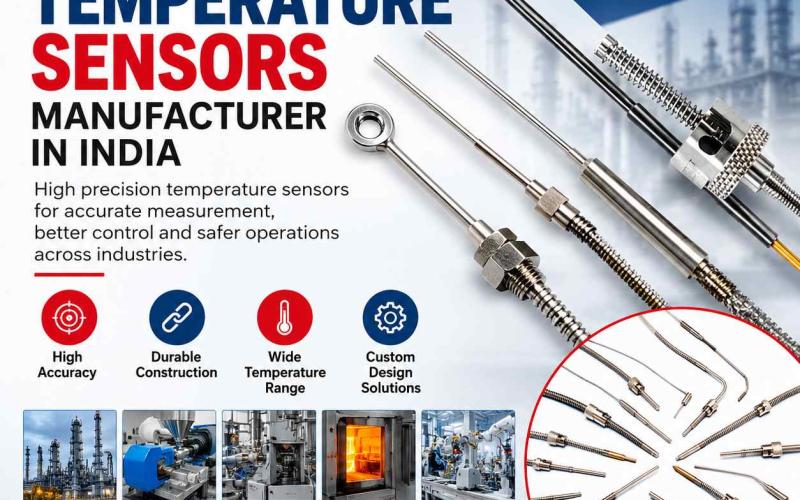
Temperature Sensors Manufacturer in India: A Practical Guide to Industrial Accuracy and Process Reliability Nexthermal
A temperature sensors manufacturer designs and supplies sensing devices that measure temperature in industrial equipment and manufacturing processes. Choosing the right sensor involves evaluating operating temperature, measurement accuracy, response time, installation conditions, and controller compatibility. For businesses seeking industrial temperature sensing solutions in India, these factors help improve process consistency, equipment reliability, and production quality.
Introduction
Temperature measurement is an essential part of modern manufacturing. From monitoring heated moulds in plastic processing to maintaining stable conditions in industrial ovens, accurate temperature readings help engineers control processes, protect equipment, and maintain consistent product quality.
Even a small measurement error can affect production outcomes. A heating system that operates above its intended temperature may damage materials, increase energy consumption, or cause unnecessary equipment wear. Conversely, insufficient heating can result in incomplete processing, inconsistent product dimensions, or rejected batches.
This is why selecting a reliable temperature sensors manufacturer is an important decision for industrial businesses. The right sensing solution should match the application, withstand the operating environment, and communicate effectively with the equipment's temperature control system.
Nexthermal, based in Bengaluru, Karnataka, provides industrial heating solutions, including temperature sensors, heating elements, and controllers. Understanding how temperature sensing technologies work can help engineers and procurement teams make better-informed decisions when evaluating suitable solutions for their operations.
What Are Industrial Temperature Sensors?
Industrial temperature sensors are devices that detect thermal conditions and convert them into electrical signals or other measurable outputs. These signals can be displayed, recorded, or processed by temperature controllers and industrial automation systems.
Unlike general-purpose temperature measuring devices, industrial sensors must often operate under demanding conditions. These may include continuous heating, vibration, mechanical contact, moisture, chemical exposure, or repeated temperature fluctuations.
A typical temperature measurement system includes three main components:
- Temperature sensor: Detects the temperature of the process, surface, liquid, gas, or equipment.
- Controller or monitoring device: Receives the sensor signal and interprets the measured temperature.
- Heating or control equipment: Adjusts system operation according to the required temperature setting.
For example, in a plastic injection moulding machine, a sensor can monitor the temperature near a heated barrel or mould. The controller uses this information to regulate heating and maintain the required process conditions.
When these components are properly selected and installed, they help manufacturers achieve repeatable results and identify abnormal temperature changes before they become larger operational problems.
Common Types of Industrial Temperature Sensors
Different applications require different sensing technologies. The best option depends on the required temperature range, measurement accuracy, response time, and surrounding environment.
1. RTD Temperature Sensors
Resistance Temperature Detectors, commonly known as RTDs, measure temperature through changes in the electrical resistance of a sensing material. Platinum RTDs are widely used in industrial applications because of their stability and measurement performance.
PT100 and PT1000 are common RTD configurations. A PT100 has a nominal resistance of 100 ohms at 0°C, while a PT1000 has a nominal resistance of 1,000 ohms at the same reference temperature.
RTDs are suitable for applications where consistent measurements are important, including process monitoring, controlled heating systems, and industrial equipment.
Their advantages include good repeatability and stable measurement performance. However, correct wiring, suitable instrumentation, installation quality, and appropriate operating limits remain essential.
2. Thermocouple Temperature Sensors
Thermocouples operate through the voltage generated by two dissimilar conductors when their junctions experience different temperatures. The resulting signal is interpreted using the appropriate thermocouple type and measurement instrumentation.
Type K and Type J thermocouples are common industrial examples. Type K is widely used for general-purpose industrial temperature measurement, while Type J is suitable for certain applications within its operating limits.
Thermocouples are often selected for heating equipment, industrial ovens, packaging machinery, and applications involving elevated temperatures.
Their practical strengths include a broad choice of configurations, rugged construction options, and suitability for many demanding environments. Their performance depends on thermocouple type, sheath material, installation, electrical interference, and the quality of the measurement system.
3. Thermistors
Thermistors are temperature-sensitive resistors whose electrical resistance changes significantly with temperature. Negative Temperature Coefficient (NTC) thermistors decrease in resistance as temperature rises, whereas Positive Temperature Coefficient (PTC) thermistors increase in resistance over their relevant operating regions.
Their high sensitivity makes them useful in applications requiring close monitoring over a relatively limited temperature range.
Typical uses include electronic equipment, HVAC systems, battery monitoring, and selected temperature control applications.
However, thermistors are not interchangeable with every industrial sensor. Their operating range, long-term stability, and compatibility with the measuring circuit must be checked before selection.
4. Infrared Temperature Sensors
Infrared temperature sensors measure thermal radiation emitted by an object, allowing temperature measurement without direct physical contact.
They can be useful when an object is moving, difficult to access, or unsuitable for contact measurement. Applications may include monitoring moving materials, certain manufacturing processes, and surfaces in automated production lines.
The measurement can be affected by emissivity, viewing angle, distance, surface condition, and environmental interference. Engineers should consider these factors when evaluating whether an infrared sensor is appropriate for the process.
How to Choose the Right Temperature Sensor for Your Application
Selecting an industrial sensor should begin with a clear understanding of the actual operating conditions rather than a product name or price alone.
Define the Operating Temperature Range
Identify the normal operating temperature, expected minimum and maximum values, and any short-duration temperature peaks. The sensor must remain suitable for the complete operating range.
Also consider the temperature of the surrounding environment, not just the measured process. Heat exposure at the mounting point can influence sensor performance and service life.
Determine the Required Accuracy
Accuracy requirements depend on the consequences of measurement errors. A process involving sensitive materials may require tighter measurement control than a basic equipment monitoring application.
Review the sensor's stated accuracy, the measuring instrument's specifications, and any applicable calibration requirements. The accuracy of the complete measurement chain matters; a suitable sensor alone cannot compensate for an unsuitable controller or incorrect installation.
Evaluate Response Time
Response time describes how quickly a sensor responds to a change in temperature. A sensor with a slow response may not represent rapid changes in a process accurately enough for the intended control task.
Response time depends on factors such as probe construction, sensing element, sheath thickness, installation method, and contact with the measured material.
For applications with rapid temperature fluctuations, engineers should assess the complete sensor assembly rather than assuming that every small sensor will automatically respond faster.
Check Materials and Environmental Conditions
Consider whether the sensor will encounter moisture, vibration, chemicals, abrasion, or repeated thermal cycling. Probe and sheath materials should be selected according to the process medium and environmental conditions.
For example, a sensor installed in a vibrating machine may require a different mechanical design from one used for stationary surface monitoring.
Confirm Controller Compatibility
Before ordering, verify the sensor type, signal characteristics, wiring arrangement, connector configuration, and controller input requirements.
An incompatible sensor and controller can produce incorrect readings or prevent the control system from operating as intended. Compatibility checks are particularly important when replacing existing sensors or modifying older industrial equipment.
Consider Maintenance and Lifecycle Cost
The purchase price is only one part of the decision. Installation time, replacement frequency, calibration needs, accessibility, and the consequences of production downtime also affect the overall cost of ownership.
A sensor that fits the application properly and can be maintained conveniently may offer better long-term value than an inexpensive option that requires frequent replacement.
Industrial Applications of Temperature Sensors
Industrial temperature sensors support a wide range of production and monitoring activities.
Plastic processing: Sensors monitor temperatures in extruders, injection moulding equipment, and heated tooling. Stable measurements help maintain suitable processing conditions and reduce the risk of inconsistent output.
Packaging machinery: Heating and sealing operations often require repeatable temperature control. Appropriate sensing helps operators identify deviations that may affect seal quality or material handling.
Industrial ovens and heating equipment: Sensors measure temperatures inside ovens, heated chambers, and other thermal processing systems. Correct positioning helps ensure that the readings represent the process being controlled.
Food processing: Temperature monitoring supports cooking, heating, cooling, and packaging operations. Sensor selection and installation must account for applicable hygiene, cleaning, and process requirements.
Pharmaceutical manufacturing: Certain processes require carefully controlled temperature conditions and documented measurement practices. Sensor selection should align with process validation, calibration, and applicable regulatory requirements.
Automotive and general manufacturing: Sensors can monitor production equipment, heated components, and selected thermal processes. Their suitability depends on the measurement point and the conditions under which the equipment operates.
Across these industries, sensor performance depends on the entire measurement arrangement, including installation, signal processing, maintenance, and control logic.
What Should Buyers Look for in Temperature Sensor Manufacturers in India?
When comparing temperature sensor manufacturers in India, procurement teams should evaluate technical suitability alongside supplier reliability.
First, review product documentation. Clear specifications should explain the sensor type, operating limits, construction, connection arrangement, and other relevant characteristics.
Second, ask about configuration options. Depending on the supplier's verified capabilities, these may include probe length, diameter, mounting arrangement, sheath material, and connector selection. Such details can be important when fitting a sensor into existing equipment.
Third, understand the supplier's quality processes and available documentation. Where required, buyers should establish whether calibration certificates, traceability records, inspection documentation, or other supporting records are available for the specific product.
Fourth, consider technical communication. A supplier should be able to understand the application requirements and help clarify important selection factors. Clear communication reduces the risk of ordering a sensor that does not match the intended installation.
Finally, assess after-sales support, replacement requirements, lead times, and the availability of relevant technical information.
These checks help buyers compare suppliers on engineering suitability rather than relying exclusively on broad marketing claims.
Nexthermal: Temperature Sensing and Industrial Heating Solutions
Industrial temperature measurement is closely connected to heating performance and process control. A heater may have sufficient power, but the process can still become inconsistent if temperature measurements are taken at the wrong location or interpreted incorrectly by the control system.
Nexthermal provides industrial heating solutions, including temperature sensors, custom heating elements, and controllers. Its Bengaluru operations serve industrial customers seeking solutions for different thermal and manufacturing requirements.
The company's temperature sensor range includes configurations such as probe-type, bolt-type, and washer-type sensors, along with thermocouple and RTD options described on its website. Selection should be based on the actual product specifications and the requirements of the intended application.
Businesses researching a suitable temperature sensors manufacturer in India can review the available product information and identify the technical details needed for their equipment.
For additional background on the company's thermal engineering focus, visit the Nexthermal About Us page. For application-related questions or product enquiries, use the contact page.
Frequently Asked Questions
1. What does a temperature sensors manufacturer do?
A temperature sensor manufacturer designs or produces devices that measure temperature for monitoring and control applications. Depending on its capabilities, the manufacturer may offer different sensor types, configurations, materials, and connection options.
2. Which temperature sensor is best for industrial applications?
The best sensor depends on operating temperature, required accuracy, response time, environmental conditions, and controller compatibility. RTDs, thermocouples, thermistors, and infrared sensors each serve different purposes.
3. What is the difference between a PT100 and a PT1000 sensor?
Both are platinum RTDs. A PT100 has a nominal resistance of 100 ohms at 0°C, while a PT1000 has a nominal resistance of 1,000 ohms at 0°C. The correct choice depends on the measuring instrument, wiring arrangement, and application requirements.
4. Why are thermocouples used in industrial heating systems?
Thermocouples are available in different types and constructions suited to many industrial heating applications. Their operating range, durability, and response characteristics depend on the selected design and installation.
5. How do I improve temperature measurement accuracy?
Choose a suitable sensor, install it at a representative measurement point, use compatible instrumentation, follow correct wiring practices, and maintain an appropriate calibration schedule.
6. Can temperature sensors be customized?
Some manufacturers offer custom configurations based on probe dimensions, mounting arrangements, materials, and connection requirements. Buyers should confirm the available options directly with the supplier.
7. Are temperature sensors compatible with industrial controllers?
Many industrial sensors can operate with compatible temperature controllers. The sensor type, input specification, wiring, and signal requirements must be checked before installation.
8. What information should I provide when requesting a quotation?
Provide the required temperature range, application details, measurement location, sensor type if known, probe dimensions, mounting requirements, controller model, operating environment, and quantity.
Industry Perspective: Building More Reliable Temperature Control
Reliable temperature measurement starts with understanding the process. Selecting an appropriate sensor, installing it correctly, verifying controller compatibility, and maintaining the measurement system can help manufacturers reduce avoidable process variation.
As industrial automation continues to develop, dependable sensor data remains essential for monitoring equipment, identifying unusual temperature changes, and making informed operating decisions. However, effective results depend on suitable engineering practices rather than sensor selection alone.
For manufacturers in Bangalore and across India, evaluating sensor specifications against real operating requirements is a practical first step towards more consistent thermal performance.
To explore available temperature sensing options and discuss your industrial application, visit for further information.
Call: 1800 891 9863
Visit Our Website: https://www.nexthermal.in/
Request a quote: https://www.nexthermal.in/contact/
Product Page: https://www.nexthermal.in/temperature-sensors/
Connect With Us
Facebook: https://www.facebook.com/nexthermal.usa/
Instagram: https://www.instagram.com/nexthermal/
YouTube: https://www.youtube.com/@nexthermal
Pinterest: https://in.pinterest.com/nexthermal/
More Products:
Electric Heating Elements manufacturer | cartridge heating element | coil heaters manufacturer | temperature sensors manufacturer | tubular heaters manufacturer | temperature controller manufacturers | Engineering services provider in india | Ceramic Infrared Heater manufacturer |Temperature Control Panel manufacturer | Heating Coil Element manufacturer | Tubular Heater manufacturer | Temperature Sensors manufacturer | Temperature Controller manufacturer