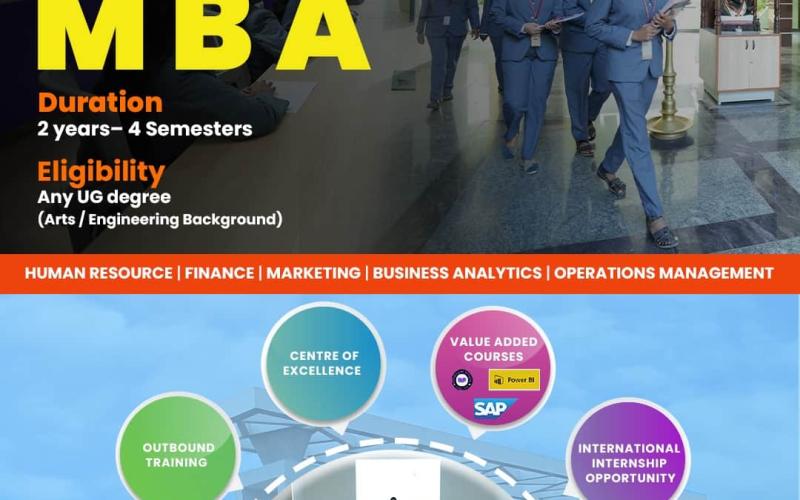
MBA in Madurai: Learning Management Beyond the Classroom
An MBA can change the way a graduate looks at business. Instead of studying one technical or academic area, the programme brings together finance, marketing, human resources, operations and business strategy. It also gives students opportunities to discuss business situations, work on projects and understand how decisions are made within an organisation.
At Solamalai College of Engineering, our MBA programme is designed to give students a strong grounding in management studies while allowing them to develop communication, analytical and professional skills through academic activities.
Understanding What an MBA Really Offers
An MBA is often associated with management jobs, but the programme covers much more than a job title. It helps students understand how different parts of a business operate together.
A management programme introduces students to areas such as:
- Financial Management
- Marketing Management
- Human Resource Management
- Operations Management
- Business Communication
- Organisational Behaviour
- Strategic Management
- Business Research
- Entrepreneurship
Finance helps students understand how money is managed. Marketing explains customers, markets, and sales. Human resources deals with people and workplace practices. Operations focuses on the processes involved in delivering products and services.
Studying these areas together gives students a broader view of business.
From Subject Knowledge to Practical Work
Management concepts become easier to understand when students get the opportunity to work with practical examples.
A classroom discussion about marketing, for instance, can be connected with the way a company positions a product. A lesson on human resources can lead to a discussion about recruitment or employee performance. Financial concepts can be connected with the way organisations plan and manage their resources.
This is where activities such as projects, presentations, case discussions, and assignments become useful.
Why an MBA Can Complement an Engineering Degree
Engineering and management may appear to be separate fields, but many workplaces need professionals who understand both technology and business.
An engineering graduate may have strong technical knowledge but later move into project coordination, operations, business analysis, technology management or entrepreneurship. Management education can add another layer to that technical background.
This combination can be useful in industries where technical teams work closely with customers, budgets, suppliers, and business managers.
The Role of Communication in Management Education
Management involves people. A manager may need to explain an idea, present a report, negotiate with a client, coordinate a team or discuss a business problem.
Technical knowledge alone may not be enough for these situations.
MBA students get opportunities to work on:
- Presentations
- Group discussions
- Business reports
- Team assignments
- Seminars
- Case-based activities
These experiences can help students become more comfortable expressing ideas in an academic and professional setting.
Building Analytical Thinking
Business decisions often involve information, numbers, and different possible outcomes. Managers need to examine the available information before deciding what to do.
MBA subjects encourage students to study problems from different angles. Financial information may reveal one situation, while customer feedback or market conditions may point towards another.
Through assignments and project work, students can practise collecting information, comparing findings and presenting their conclusions.
This analytical approach can be useful across finance, marketing, HR, operations and other management functions.
Learning Through Projects
Projects are an important part of postgraduate management education because they bring several skills together.
A student may study a company's marketing strategy, examine employee satisfaction, analyse customer preferences or review an operational process.
A project usually involves several stages:
Selecting a topic → Collecting information → Studying the findings → Preparing the report → Presenting the work
The value is not only in completing the report. Students also learn how to organise information, communicate findings, and answer questions about their work.
At Solamalai College of Engineering, project activities form part of the academic experience and give students opportunities to connect management concepts with business situations.
Different Directions After an MBA
An MBA does not restrict graduates to a single career path. The area a student enters can depend on specialisation, skills, interests and experience.
Career areas can include:
- Marketing
Sales, brand management, market research and customer-related roles. - Finance
Financial planning, banking, accounting-related positions and corporate finance. - Human Resources
Recruitment, employee relations, training and performance management. - Operations
Production planning, supply chain, quality and process management. - Business Analysis
Studying business information and helping organisations make informed decisions. - Entrepreneurship
Starting and managing a business using knowledge gained across different management functions.
Students can also pursue higher education or professional certifications after completing their degree.
What Makes a Good MBA Programme?
The name of the degree alone does not determine the quality of the learning experience. Students should consider the environment in which the programme is delivered.
Important areas include:
- Faculty expertise
- Course structure
- Classroom teaching
- Project opportunities
- Library and computer facilities
- Industry interaction
- Placement training
- Student activities
- Opportunities to develop communication skills
A programme that provides space for both academic study and practical activities can give students a more useful postgraduate experience.
Why Study MBA in Madurai?
Madurai is home to students from the city as well as neighbouring districts. For graduates who want to pursue postgraduate education without moving far from their families, studying within the city can be a practical choice.
An MBA in Madurai can also bring together students from different educational and professional backgrounds. These interactions can add variety to classroom discussions because each student may approach a business problem differently.
A Degree That Can Open More Than One Door
An MBA can be useful for a graduate who wants to enter management, add business knowledge to an existing qualification, prepare for entrepreneurship, or explore a new professional direction.
The two years can be used to understand business functions, work with different types of people, complete projects and develop skills that extend beyond the classroom.
For students considering an MBA in Madurai, the programme at Solamalai College of Engineering provides an academic setting where management learning is supported through classroom study, projects, presentations, and career-related activities.
The goal is straightforward: to give students a sound understanding of management and the space to develop skills that can support their next professional step.